
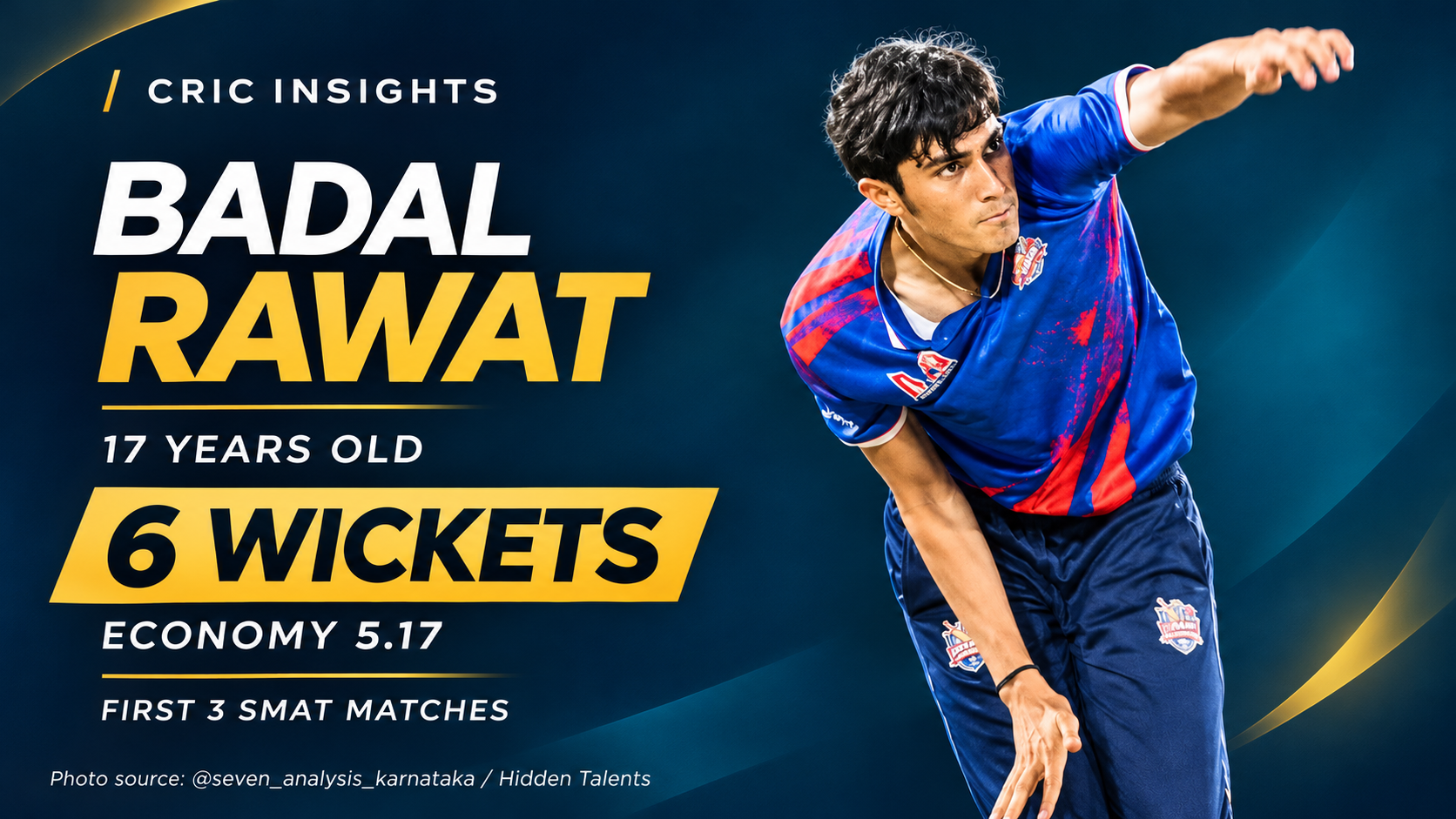
A target of 205. Prithvi Shaw, Arshin Kulkarni and Sahil Parakh in the opposition. Your first senior T20 appearance. There are comfortable ways to introduce a teenage spinner to this level; this was not one of them.
Badal Rawat finished with three wickets for 12 runs. Across four overs, Maharashtra did not hit him for a single boundary. Puducherry won by 15 runs, and their 17-year-old left-arm wrist-spinner had removed precisely the batters who could have carried the chase home.
Two wickets against Tripura followed, then another against Assam. His first three SMAT matches have brought six wickets for 62 runs in 12 overs, at an economy of 5.17. Maharashtra introduced him; the next two appearances have given that introduction a follow-up.
That is what makes this more than an attractive debut scorecard. A young Indian spinner who can take wickets without surrendering control is worth understanding. For an IPL squad looking beyond the most familiar names, Rawat has supplied a reason to look closer.
The wickets arrived when they mattered
Kulkarni had made 33 when Rawat dismissed him at 4.4 overs, leaving Maharashtra 44 for one. It was an important start, but the chase still had substantial batting behind it.
Parakh then advanced to 57, with Shaw still at the other end. Against a large target, a settled pair can keep a side interested because one explosive over changes the equation. Rawat kept denying Maharashtra that release.
At 11.2 overs, he removed Parakh with the score on 115. Maharashtra needed 90 from 52 balls. At 13.2, he ended Shaw’s innings on 32: 128 for three, with 77 required from 40 deliveries.
The significance lies in the stage of those dismissals as much as the names. Parakh was established. Shaw had the opportunity to build on his start. Rawat did not merely make life awkward for new batters; he removed players capable of transferring the pressure back to Puducherry.
Thirteen of his 24 deliveries were dots. None produced a four or six. In a chase of 205, that is a sustained restriction on the batting side’s options. Each delivery without a boundary increases the urgency elsewhere. Rawat gave Puducherry the breathing room to make that pressure count.
Why 3/12 does not tell the whole story
Maharashtra finished on 189 for five. Rawat conceded 12 in four overs, meaning their other 177 runs came from the remaining 16 overs—more than 11 an over.
That comparison puts his performance in perspective. This was not an innings in which every bowler found control and a teenager simply benefited from the same conditions. He maintained an economy of three while runs flowed much more quickly in the other overs.
A wicket-taking spinner can sometimes be expensive. A containing spell can leave dangerous batters in place. Rawat delivered both wickets and restraint in the same performance. In a match decided by 15 runs, that combination mattered enormously.
Two more wins, two different jobs
Against Tripura on 16 November, Puducherry posted 209. Rawat took two for 31 from four overs in a 40-run win, with contributions at different stages of the defence.
At 3.5 overs, he dismissed Mandeep Singh for six, leaving Tripura 47 for two. His captain had used him inside the powerplay, and he responded with a wicket. At 8.5, he ended Manisankar Murasingh’s innings on 21: 84 for three. Murasingh had already taken six wickets in the match; preventing him from extending his batting contribution delivered another setback to the chase.
There is a meaningful distinction here. A spinner protecting a large total can concentrate on limiting damage. Rawat also reduced the opposition’s options by taking wickets. It was another contribution to a defence, rather than a wicketless follow-up to an exceptional debut.
The Assam match on 18 November required a different kind of contribution. Chasing Puducherry’s 192 for six, Assam lost their first four wickets for 24. Rawat’s job was to help keep that advantage intact and deny the batting side a route back.
He finished with one for 19 from four overs. At 9.5, he bowled Saahil Jain for 19, leaving Assam 62 for five. He had also caught Sibsankar Roy off Adil Ayub Tunda. Assam finished on 131 for seven, and Puducherry won by 61 runs.
Across the three matches, a clearer picture emerges. Against Maharashtra, he removed established batters to change the chase. Against Tripura, he took wickets inside the powerplay and beyond it. Against Assam, he sustained the pressure created by the early breakthroughs. He completed four overs and took a wicket in each victory.
- Maharashtra, 14 November — 4 overs, 12 runs, 3 wickets; Puducherry won by 15 runs.
- Tripura, 16 November — 4 overs, 31 runs, 2 wickets; Puducherry won by 40 runs.
- Assam, 18 November — 4 overs, 19 runs, 1 wicket; Puducherry won by 61 runs.
His six wickets have cost 10.33 runs apiece, with a bowling strike rate of 12—one wicket every 12 deliveries. Three games remain a small sample, but the combination of wickets and scoreboard control is visible within it.
There was a foundation before the debut
Born on 10 January 2009, Rawat is still 17. He also appears in Puducherry’s Vinoo Mankad Trophy Under-19 squad. His progress spans the junior setup and an early opportunity in the senior side.
There was a successful defence in Under-19 cricket too. Against Goa in the Vinoo Mankad Trophy, Puducherry made 214 and dismissed their opponents for 200. Rawat contributed three for 29 to the 14-run win. It was a different level of cricket, but another meaningful instance of taking wickets while helping a team protect a target.
Earlier in 2026, he played 11 matches for Karaikal Kniights in the Pondicherry Premier League. His return was 13 wickets from 39 overs, conceding 276 runs: an economy of 7.08, an average of 21.23 and a best of three for 14.
The individual matches add useful detail. His 3/14 against Ossudu Accord Warriors demonstrated wicket-taking impact. Another appearance brought one for 14 from four overs. There were tougher days too, including wicketless spells costing 35. Across the campaign, however, his economy remained close to seven.
The Maharashtra performance therefore had a playing foundation behind it. He had already worked through a sequence of league games before making a much bigger impression on senior T20 debut. Those league figures must remain separate from his official senior T20 career statistics; combining the two would give a misleading career total.
The IPL role that makes him interesting
A left-arm wrist-spinner gives an attack a different option. Difference alone, however, does not secure an IPL role. A bowler must make that option useful: threaten a wicket while giving his captain confidence that the scoreboard will remain manageable.
Rawat’s Maharashtra spell is an encouraging demonstration of precisely that combination. For a franchise with an established frontline spinner, he could be an interesting Indian reserve to develop. The appeal would be a distinct middle-overs option and a player young enough to grow within the setup over several seasons.
His age is not the entire argument. The stronger evidence is what he did with the opportunity: a debut under the pressure of a large chase, established opponents, settled batters removed and no boundaries conceded.
That is why he belongs in the scouting conversation. The wicket-taking promise and scoreboard control have appeared together in a meaningful senior performance. A team seeking that kind of Indian spin option should have a reason to examine him closely.
The next two matches have strengthened the introduction
Three productive appearances do not guarantee an IPL contract. Extending that impact across a longer season remains part of the assessment. His senior career is at an early stage.
But a small number of opportunities should not make us ignore what a player has done with them. Against Maharashtra, Rawat dismissed the batters who could win the match, denied the boundaries needed to sustain the chase and played a central part in Puducherry’s victory.
Maharashtra brought him attention. His contributions against Tripura and Assam have given that attention a stronger foundation. Wickets and control together: that is the most interesting part of Badal Rawat’s emerging IPL case.
What’s your take?आपकी क्या राय है?
Keep it about cricket. Be respectful and avoid sharing personal information.बात क्रिकेट की रखें। सम्मान से अपनी राय दें और निजी जानकारी साझा न करें।
Loading comments…कमेंट लोड हो रहे हैं…