
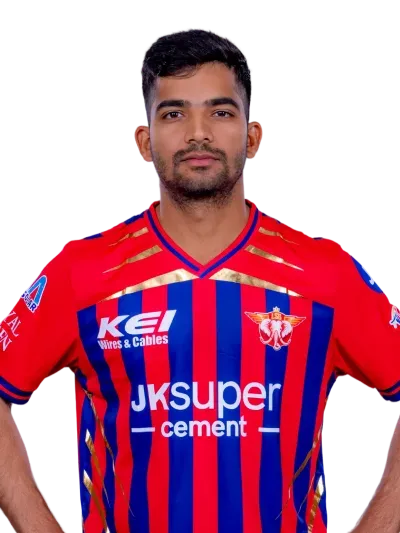
A television that went off in the middle of the bidding
Akshat Raghuvanshi’s auction story includes an unexpected interruption. Friends were celebrating in the room, someone touched the remote and the television went off while the bidding was still climbing. Avesh Khan then became his source of updates over the phone. Speaking to Cric Insights ahead of IPL 2026, the Madhya Pradesh batter recalled the nervous build-up, a sleepless night and the relief when the first bid arrived.
Lucknow Super Giants eventually secured him for ₹2.2 crore. Raghuvanshi said he had expected some interest after a good season and encouraging trials, but that expectation did not remove the uncertainty. He was in Ratlam for a divisional match around auction time. Once selected, his first call was to his father—the person who had introduced him to cricket. At the time of this interview, he was preparing at LSG’s preseason camp in Chennai.
Cricket began at home in Ashoknagar
Raghuvanshi’s earliest cricket memories are partly preserved in family photographs and videos. His father had brought cricket equipment for his brother, and he began picking it up and playing too. Formal infrastructure came much later. In Ashoknagar, there was no academy or turf wicket available to him in those early years; his father bowled, his brother fielded and others at the ground occasionally joined in.
Around the age of 10, the family moved to Indore to give his cricket a more structured setting. He later entered the MPCA residential academy while his family returned home. The first approach had not resulted in admission: the concern was that he was too young to live away from his family. When his father tried again, the opportunity opened. Raghuvanshi also remembered choosing to face the older Under-19 bowlers during a trial rather than stay with the younger group.
The coach who rebuilt the details
Amay Khurasiya’s influence, in Raghuvanshi’s account, was technical as well as disciplinary. Grip, stance, shots and the way he approached batting were all shaped in that environment. The demand was not merely to look talented in the nets, but to work consistently even when tired.
One academy memory concerned a misunderstanding before a medical checkup. New players had been told not to eat breakfast and believed they should miss the training session as well. The coach called them back and sent them running. Raghuvanshi remembered the running, but not the precise number of laps. The lesson that stayed with him was personal responsibility for his cricket.
A second chance in a practice game
He went on to play across Madhya Pradesh’s age-group levels before reaching the senior team. Asked about Chandrakant Pandit, Raghuvanshi recalled a match-simulation session in which the coach was umpiring. He believed he was out lbw early, but Pandit allowed him to continue because he wanted a longer look at a player he had heard about from other coaches.
Raghuvanshi said he then made around 160 in that practice game. The extended opportunity gave Pandit a better look at his batting and became a memorable early interaction between player and coach.
Why the Madhya Pradesh league mattered
The state T20 league offered something different from the longer-format cricket that had dominated his schedule. There were crowds, live broadcasts and IPL scouts watching. Raghuvanshi felt that learning to handle that attention helped him, and other local players, prepare for higher-profile opportunities.
It also pushed him to reconsider the tempo of his batting. He wanted to develop more scoring options and a stronger strike rate rather than keep playing only in the familiar classical style. That change brought some early dismissals. He discussed the trade-off with his father: comfortable returns at the existing level were one option; trying to develop a distinct attacking game that might take him higher was another. His father backed the experiment.
The real story behind the six-hitting practice
During the conversation, Raghuvanshi corrected two eye-catching details put to him. He said he had attended trials for roughly seven or eight IPL teams, rather than nine. He also did not endorse the suggestion of 300 sixes in a six-hour session. His recollection was of hitting roughly 150–200 in a day during dedicated power-hitting practice around the period just after the Covid disruption.
At Faith Cricket Club, the point of those sessions was to attempt attacking shots repeatedly and expand what felt possible against different deliveries. Over time, that work began to appear in matches. He named the pull and upper cut among his favourite shots, and Rohit Sharma as the batter he admired for the time, elegance and class in his batting.
A preferred position, not a promised role
Raghuvanshi was excited about meeting Rishabh Pant and Nicholas Pooran, particularly the chance to watch and learn from Pooran’s power game. But he was careful when asked about his own place in the side. At the time of the interview, a specific LSG role had not yet been communicated to him.
Although the question raised the possibility of finishing, his personal preference was to bat in the top order. With the franchise role still to become clear, his stated objective was to help his team win whenever an opportunity came.